
Introduction
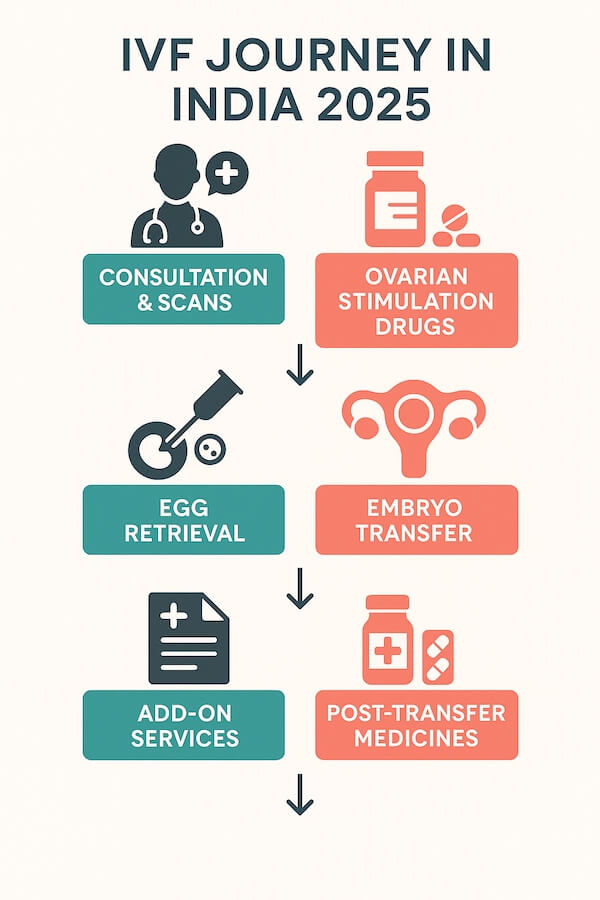
Starting IVF for the first time can feel overwhelming, especially when you are handed a list of injections you have never heard of. This IVF injection guide for beginners is designed to explain every type of injection used in a standard IVF cycle, how they work, how to store them, and how to administer them safely at home.
At ivfinjection.in, we speak to hundreds of patients beginning their IVF journey every month. The questions below are the most common questions they ask — and the answers have been prepared with guidance from our licensed pharmacist team.
Types of Injections Used in an IVF Cycle
- Ovarian stimulation injections (FSH/rFSH) — such as Folisurge 300 and Gonal F 300, these stimulate your ovaries to produce multiple follicles
- HCG trigger shot — administered 34 to 36 hours before egg retrieval to trigger final egg maturation
- Progesterone support injections and gels — given after embryo transfer to support implantation and early pregnancy
- Blood thinners (if prescribed) — such as Clexane (enoxaparin), given to women with clotting disorders
- GnRH agonists or antagonists — used to prevent premature ovulation during the stimulation phase
How to Self-Inject IVF Medicines at Home
Most IVF injections are subcutaneous, meaning they are injected just under the skin in the fatty tissue of the abdomen, thighs, or upper arms. Your IVF clinic’s nurse will provide a training session before you start injecting. Here are the general steps:
- Wash your hands thoroughly before handling any injection
- Take the injection out of the refrigerator 15 to 30 minutes before use to bring it to room temperature
- Clean the injection site with an alcohol swab and let it dry
- Pinch the skin and insert the needle at a 45 to 90 degree angle as per your training
- Inject slowly, then withdraw the needle and apply gentle pressure with a clean cotton swab
- Rotate injection sites daily to prevent bruising and skin irritation
Folisurge vs Gonal F — Which is Better?
This is one of the most frequently asked questions by patients beginning IVF. Both Folisurge 300 and Gonal F 300 contain recombinant follitropin alfa (rFSH) at the same dose of 300 IU. They are bioequivalent, meaning they have the same active ingredient and the same clinical effect. The difference is in brand, manufacturer, and price.
| Feature | Folisurge 300 | Gonal F 300 |
| Active Ingredient | Follitropin alfa 300 IU | Follitropin alfa 300 IU |
| Manufacturer | Bharat Serums (India) | Merck (Germany) |
| Price (approx.) | More affordable — Indian brand | Higher cost — imported brand |
| Clinical Efficacy | Bioequivalent to Gonal F | Reference standard rFSH |
| Storage | 2 to 8 degrees Celsius | 2 to 8 degrees Celsius |
| Availability in India | Widely available | Widely available |
| Device | Prefilled pen injector | Prefilled pen injector |
| Doctor Preference | Commonly prescribed in India | Often preferred in international protocols |
Bottom line: If your doctor prescribes rFSH and does not specify a brand, Folisurge is the equivalent at a significantly lower price. If your protocol specifies Gonal F specifically, use Gonal F. Both are genuine, effective medications.
FAQs
Q1. What injections will I need for IVF?
A typical IVF cycle involves four categories of injections: (1) FSH stimulation injections like Folisurge or Gonal F to grow multiple follicles, (2) a GnRH antagonist like Cetrotide or Ganirelix to prevent premature ovulation, (3) an HCG trigger shot 34 to 36 hours before egg retrieval, and (4) progesterone support after embryo transfer. Your specific protocol will be designed by your fertility specialist.
Q2. Is Folisurge 300 the same as Gonal F 300?
Yes. Both Folisurge 300 and Gonal F 300 contain 300 IU of recombinant follitropin alfa and are clinically bioequivalent. Folisurge is the Indian brand (Bharat Serums) and is more affordable. Gonal F is the imported brand (Merck). Your doctor will prescribe whichever suits your protocol and budget.
Q3. How do I store IVF injections at home?
Most IVF injections — including Folisurge, Gonal F, and HCG — require refrigeration at 2 to 8 degrees Celsius. Do not freeze them. Keep them in the main compartment of your fridge, not the door. Progesterone gels like Naturogest may be stored at room temperature below 25 degrees Celsius. Always check the specific storage instructions on your medicine label.
Q4. Can I miss a dose of IVF injection?
Missing an IVF stimulation injection can affect your cycle outcome. If you miss a dose, contact your IVF clinic immediately — do not double up on your own. Your doctor may adjust your protocol or advise you to take the missed dose as soon as possible. Set daily phone reminders for your injections to avoid missing them.
Q5. Will IVF injections hurt?
Most patients find IVF injections manageable. Subcutaneous injections (under the skin) cause minimal pain — similar to a small pinprick. The most common discomfort is mild bruising at the injection site, which can be reduced by rotating sites and keeping injections at room temperature before use. Intramuscular injections (if prescribed) cause slightly more discomfort but are still well-tolerated by most patients.